





The 8 best undated planners of 2026 (and 4 I wouldn't buy)

Eight undated planners (refillable, bound, and discbound). Twelve questions worth asking before you spend $50+. Real customer feedback for the seven we don't make, real testing notes for the one we do. We win some questions and lose others. Both are useful to know.


- The 4 we'd buy: MDS Modular Planner, Hobonichi Techo Cousin, Hobonichi Weeks, Plotter Mini 5.
- The 4 we wouldn't: Filofax Original A5, Moleskine 18-Month Weekly, Levenger Circa Junior, Erin Condren Undated LifePlanner. Reasons in each verdict below.
- Paper weight is the first filter. 100 GSM is the sweet spot. We tested ~15 weights at our paper factory in southern China. 80 GSM bleeds with gel pens. 120 GSM kills portability. Tomoe River at 52 GSM doesn't bleed but ghosts.
- Refillable beats bound for most people. Three-year cost: MDS Modular ~$70-83, Filofax ~$95-130, vs Erin Condren ~$165 and Full Focus ~$540.
- If you've abandoned a planner before, refillable + undated is mandatory. Empty pre-printed dates create guilt loops; blank pages just wait for you.
- One-line verdict: Our Modular is built for people who value focus and disconnecting from screens. If that's you, start there. If you want a bound aesthetic experience and tolerate Tomoe River ghosting, get a Hobonichi. If you want a buy-it-for-life leather object, Plotter.
In This Article
- What is an undated planner?
- Q1: Will it survive a year of daily use?
- Q2: Will the paper bleed through?
- Q3: Can I refill it, or is it disposable?
- Q4: Will it adapt to my productivity style?
- Q5: Will it fit in my bag?
- Q6: Will I get bored of the layout?
- Q7: Is it set up for time blocking?
- Q8: Can I track habits and goals?
- Q9: What if I skip days?
- Q10: What's it cost over 3 years?
- Q11: Where can I see one before I buy?
- How we built ours: paper, binder, inserts
- Quick comparison table
- 5 mistakes to avoid
- How we did this comparison
- FAQ
An undated planner is a planner with blank date fields, so you write them in yourself. That sounds like a small thing. It isn't. It's the design choice that decides whether you'll still be using your planner in October.
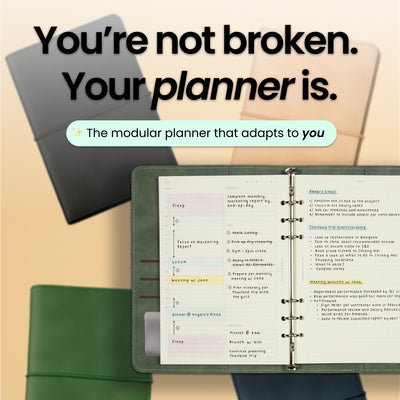
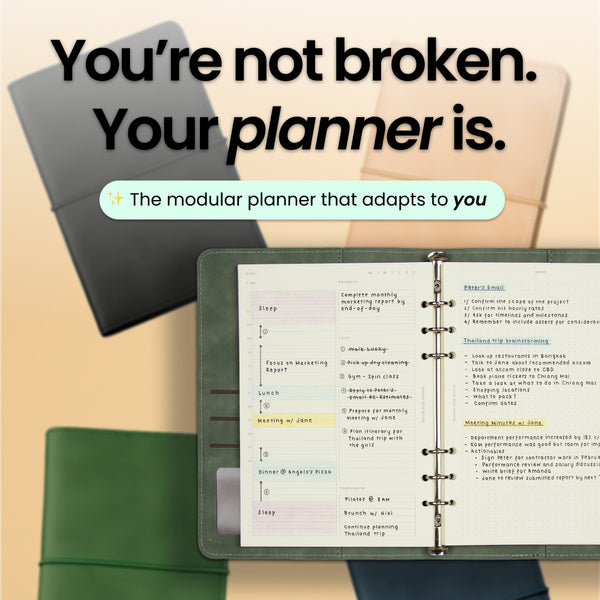
I'm Damien, co-founder of Minimal Desk Setups. We design and manufacture physical productivity tools out of Melbourne, with our own factories in Southern China. One of the things we make is a refillable A5 modular planner, which is on this list of best undated planners for 2026. I'm not going to pretend it isn't, and I'm not going to pretend it wins every comparison. It doesn't. What I am going to do is walk through the twelve questions worth asking before you spend $50 on any planner, refillable or bound, and tell you which planner wins on each, with real customer feedback for the ones we don't make and real testing notes for the one we do.
This guide is built for the person who values focus. Who's tried four productivity apps. Who wants to disconnect from screens for an hour a day and actually plan. If that's you, this should be the comparison you needed.
Quick context for how I use mine: I do my weekly planning Sunday nights, my daily blocks the night before, and I review what I shipped on Friday afternoons. I write with a Lamy Safari and whatever ink is in it. Tomorrow's daily insert is sitting open next to me right now. The fact that I run my day on a refillable analog system, not Notion, isn't a marketing line. It's why we built the product.
Here's the mechanism, because the "analog vs apps" debate gets hand-waved a lot. If your phone is the source of your distraction, planning on your phone is asking the arsonist to fight the fire. Your brain attaches the dopamine of a notification, an Instagram check, a Slack ping to the same physical object you're trying to plan focused work in. The device that fragments your attention can't also be the place you defragment it. Cal Newport calls this trap out in Deep Work: every digital tool that touches your workflow carries an attentional cost, and you can't escape that cost by opening a different app on the same screen. An analog planner cuts the loop because the paper doesn't have notifications, can't open Twitter, and doesn't compete for your attention with anything else. That's the boring, real reason it works for people who've tried four productivity apps and bounced off all of them. The eight planners below are the practical options for actually doing it.
What is an undated planner, and why does it exist?
An undated planner has structured templates with blank date fields. Monthly grids, weekly columns, daily time blocks. You write the dates in. Within the category you'll see three layout depths: an undated monthly planner (one-month-on-two-pages spreads, useful for big-picture planning), an undated weekly planner (week-on-two-pages or vertical-week formats), and an undated daily planner (day-per-page with hourly columns for time blocking). The eight planners on this list ship with at least one of these layouts. Most ship with all three. There are then three structural sub-types worth knowing.
Bound undated. A single book, like a Moleskine 18-Month Weekly or a Hobonichi Weeks. Pages are fixed in printed order. You can't rearrange.
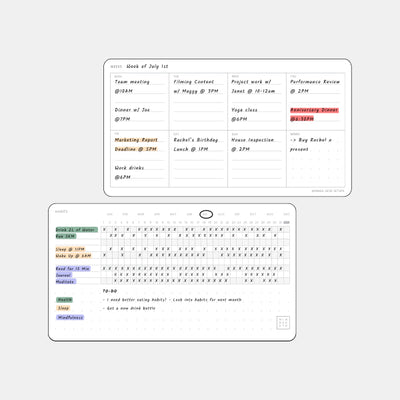
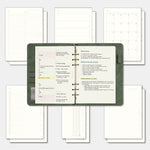
Refillable systems. A binder with swappable A5 planner inserts (or whichever size the system uses). Filofax, Plotter, and our MDS Modular sit in this category. You buy the binder once and refill the pages over time. The MDS A5 planner inserts include monthly, weekly, daily, focus, goals, habit-tracker, and wellness layouts so you can mix any combination of undated monthly, undated weekly, and undated daily formats in the same binder.
Discbound systems. Like refillable, but rings are replaced with discs. Pages clip on and off without opening anything. Levenger Circa is the most established. Happy Planner and Atoma also use this format.
Undated planners exist because dated planners create a guilt loop. You miss a day. The next day you see the empty pre-printed Tuesday and skip it. By the second week you're avoiding the planner. By the third you've abandoned it entirely. Undated layouts cut the guilt at the source. Skip a day, the next page just waits for you. That's the whole pitch, and it's why most people who switch don't go back.
Here's a customer quote that sums up the abandonment problem better than I can:
"For years I bought planners and then that day happens, you miss a day, then the next, and you're left with a big empty book. I chose this set up as I can build it for one month. New month, replace the rest. That's history. That's gone."
— John K., verified MDS buyer, 5 stars
Q1: Will it survive a year of daily use?
This is the build-quality question. The answer depends on whether you're carrying it daily or leaving it on a desk.
If it goes in a tote, the cover material and binding mechanism take all the abuse. Fountain pen ink, coffee, getting crushed under a laptop. After 12 months a mediocre cover will look mediocre. A good one will look better than the day you bought it.
What buyers actually say. Filofax's leather lines, particularly the Holborn and Lockwood, hold up well over years according to r/Filofax users. Their cheaper Original line uses a "plastic-coating" leather treatment that one user noted "won't patina or soften." It looks fine but doesn't age. Hobonichi's standard cover is canvas and survives daily carry well, though many users add a separate clear PVC cover for extra protection. Plotter uses higher-grade Italian leather and ages beautifully but starts at over $200 just for the binder.
For our Modular, here's what one customer said after a few weeks of daily transport:
"The binder feels like it is of really good quality. The material is soft, and after a couple of weeks of being in and out of my bag, it isn't tattered or scuffed."
— Ainsley B., verified buyer, 5 stars
Verdict. Filofax Holborn or Lockwood for vintage leather feel, though you're paying $150-200 for the binder alone. Plotter if budget isn't a concern and you want a buy-it-for-life object ($220+). MDS Modular at $58.50 for daily-carry durability without the leather-aging premium. The Filofax Original A5 is similarly priced to us at around $80 but uses a plastic-coated leather that doesn't patina (Reddit users have flagged this for years). Avoid the Filofax Original and Moleskine if you want something that ages well. Decision rule: if you carry it daily, prioritize cover material over aesthetic, and don't conflate "leather-look" with "leather."
Q2: Will the paper bleed through?
This is the question I get asked most, and it's the question that drove a year of paper testing for us. So this section is going to be longer than the others. If you only read one section of this article, read this one.
Here's the short answer. 100 GSM is the sweet spot for an everyday undated planner. 80 GSM is what's in your printer and it bleeds with most gel pens. 120 GSM feels luxurious but the math gets brutal: a 90-page refill at 120 GSM is noticeably thicker than the same refill at 100 GSM, and that thickness is what kills your daily-carry use case.
Tomoe River paper, used in Hobonichi, is the famous outlier at 52 GSM. It won't bleed because the paper is engineered for slow ink absorption, but it ghosts visibly through to the next page. Some people love it. Some find it distracting. It's a taste call, not a quality call.
How we landed on 100 GSM. Sam, Kenny and I went back and forth for a couple of months on what weight to land on. The premium planner brands cluster at 80-90 GSM (Filofax's Luxury refills are 90 GSM; their Minimal and Classic lines are 80). Moleskine is also around 80. There's a real argument for staying in that range. Lighter paper means more pages per refill, lower unit cost, and the planner stays slim. The counter-argument is that 80-90 GSM ghosts and bleeds with anything heavier than a ballpoint, which is exactly what our customers told us they hated about previous planners.
So instead of arguing about it from spec sheets, we went to our paper factory in southern China and ran the matrix. The factory team did custom sample runs in 10 GSM increments. About 15 weights, three different surface coatings, against four pen types. Most stationery brands pick a paper from a catalogue. We had the option not to, so we used it.
Here's what the test matrix looked like, in the simplest possible form. Bleed means ink visibly comes through to the next page. Ghost means you can see the writing as a faint shadow but it doesn't transfer. Clean means neither.
| Paper weight | Lamy Safari (fountain pen, fine nib) | Pilot G2 (gel pen, 0.7mm) | Muji 0.5mm (gel pen) | Generic ballpoint |
|---|---|---|---|---|
| 80 GSM (standard copy paper · Filofax Minimal/Classic lines · Moleskine) | Bleeds | Bleeds | Ghosts heavily | Clean |
| 90 GSM (Filofax Luxury line) | Bleeds slightly | Ghosts heavily | Ghosts | Clean |
| 100 GSM, what we ship | Clean | Clean | Clean | Clean |
| 110 GSM | Clean | Clean | Clean | Clean |
| 120 GSM | Clean | Clean | Clean | Clean |
110 and 120 GSM didn't bleed, didn't ghost, and felt great to write on. The problem with going heavier was binder math and unit cost. Our refillable system holds about 90 pages, and at 120 GSM that stack pushes the binder past the thickness where it slides into a tote naturally. Past that thickness, the planner stays on a desk. People stop carrying it. Stop carrying it, stop using it. Heavier paper is also meaningfully more expensive at scale, which would push retail above the price our customers were telling us felt fair.
So 100 GSM is where Sam, Kenny, the southern China team and I landed together. Zero bleed-through with fountain pens, gel pens, fineliners, and even cheap rollerballs. Ghosts only when you press hard with a thick-line pen. The binder stays slim enough to carry. Unit economics work at our retail price. The customers got the right answer.

And here's a still from inside our paper factory in southern China, where we ran the testing.

The other thing we cared about was surface finish. Glossy paper feels expensive but ink sits on top and smudges. Rough paper drags pens. We landed on a slight smoothness that's hard to describe in words. The southern China team called it "a little buttery." That phrase made it into the spec sheet.
Why off-white instead of bright white. Off-white reduces glare under desk lamps and natural sunlight, and it's easier on the eyes during longer planning sessions. Bright white is what cheap copy paper looks like. Off-white reads as premium and reads more comfortably. Small thing, but it's the kind of detail that adds up.
What buyers say about competitor paper.
- Moleskine. The most-cited complaint on r/PlannerAddicts. "Moleskine paper is genuinely terrible for fountain pens. Bleeds, feathers, ghosts." This is consistent feedback going back years.
- Hobonichi (Tomoe River). "The paper is incredible and the planner itself is the perfect fusion of minimalism and quality." Most users love it. The only consistent complaint is ghosting.
- Filofax inserts. Quality is mixed because Filofax sells multiple paper grades. Reddit users consistently recommend buying premium inserts (Hemlock & Oak make popular Filofax-compatible refills) rather than the standard ones that ship with the binder.
- Levenger Circa. Complaints on r/DiscBound about disc paper not laying as flat as users expected, and inconsistent paper weights between SKUs.
And from our own customers:
"The pages are soft so I was worried how they'd be for writing but they're great and ink doesn't bleed through!"
— Skylar K., 5 stars
"Works great with any pen I throw at it, including fountain pens."
— Sarah G., 5 stars
Verdict. MDS Modular wins this question for everyday use across all pen types. Hobonichi wins for fountain pen purists who don't mind ghosting. Avoid Moleskine if you write with anything other than ballpoint. Decision rule: if you write with fountain pens or gel pens daily, paper weight is the first filter and 100 GSM is the floor.
Q3: Can I refill it, or is it disposable?
Most planners are bought once and abandoned within months. Refillable planners change that math. You buy the binder once. When you're done with a stack of pages, pull them out, archive them, slot in fresh ones.
Refillable: MDS Modular, Filofax, Plotter, Levenger Circa. The binder is the asset. Pages are consumable.
Bound (disposable in the planner sense): Hobonichi Cousin, Hobonichi Weeks, Moleskine 18-Month Weekly, Erin Condren Undated LifePlanner. When the pages are full, you buy a new planner.
Erin Condren is the interesting outlier here. They sell an undated LifePlanner, but the binding is coil. You can't add or remove pages. It's "undated" in the sense that you fill in the dates yourself, but it's not refillable. Important distinction if you thought you were buying a system.
The cost question gets its own section later (Q10). The use-case question is this: if you change your planning style every few months, get a refillable system. If you find a layout you love and stick with it for years, a bound planner is fine. Most people overestimate how stable their planning style is. We've seen this in our own customer data. The number-one reason customers come back to buy a second insert pack is they switched layouts.
If you're choosing between MDS Modular and Filofax specifically, here's the honest split. Filofax wins on accessory ecosystem (third-party insert market is huge, dozens of compatible brands). We win on price (our binder is $58.50 vs Filofax's $80 Original or $150+ Holborn) and on insert design. Our 11 inserts are purpose-built per use case (Focus, Goals, Wellness, Habit Tracker, etc.) instead of mixed-pack catch-alls. If you want the deepest accessory pool, Filofax. If you want a system designed around how knowledge workers actually plan, ours.
Verdict. Tied between MDS Modular, Filofax, and Plotter for refill flexibility. Levenger Circa wins on swap speed (no opening rings, just snap pages on and off). Avoid bound planners if you've abandoned a planner before. Decision rule: if you're not 100% sure what layout you want, get refillable.
Q4: Will it actually adapt to my productivity style?
This is the question almost every planner article skips, because most planners can't really answer it.
There's research from Carson Tate (founder of Working Simply, author of Work Simply) that splits people into five productivity styles based on how they think about and execute work. Each style needs different tools. A rigid pre-printed planner only serves one style. A modular system serves all five. We didn't pick our 11 insert types randomly. We mapped them to Tate's framework.
Here's how the five styles map to insert types, and which planners on this list serve which:
| Productivity style | What they need | Best planners |
|---|---|---|
| Prioritizer (data, logic, sequence) | Eisenhower matrix, daily time blocks, goals tracker | MDS Modular (Focus + Daily + Goals inserts), Hobonichi Cousin (hourly columns) |
| Planner (structure, detail, sequence) | Detailed weekly + monthly + habit tracker layered together | MDS Modular (multi-insert layering), Erin Condren (rich pre-printed weeklies) |
| Visualizer (big picture, sketch, brain dump) | Dot-grid pages, mind-map space, monthly view without daily pressure | MDS Modular (Dot Grid insert), Hobonichi (yearly index page), Filofax with custom dot grid inserts |
| Arranger (people, meetings, energy) | Meeting notes, wellness tracker, social planning, weekly view | MDS Modular (Wellness + Notes inserts), Erin Condren (relationship-tracking modules) |
| Adapter (changes style by week or day) | The ability to swap layouts without buying a new planner | MDS Modular (whole point of the system), Filofax, Levenger Circa |
The Adapter is the most-common style and the one bound planners fail completely. If you're somewhere between styles, or your style shifts week to week, modular is the only category that works.
- If you alphabetize your to-do list or sort by urgency, you're a Prioritizer.
- If you've ever rebuilt a Notion workspace because the structure stopped working, you're a Visualizer.
- If your planner has detailed habit trackers, monthly goals, and weekly reviews layered together, you're a Planner.
- If you think in terms of who you're meeting with and how the day will feel, you're an Arranger.
- If you can't pick one and your style shifts week to week, you're an Adapter. Most knowledge workers are. We are too.
Verdict. MDS Modular wins on style coverage. We shipped the most insert types of any system on this list, and we mapped them to research, not vibes. Filofax is a strong runner-up if you're willing to buy third-party inserts to fill the gaps. Bound planners (Moleskine, Hobonichi, Erin Condren coil-bound) only serve one style. Decision rule: if you can't pick a single productivity style with confidence, you're an Adapter, and you need modular. (If you have ADHD, the Adapter framing applies harder. We have a deeper guide on planners for ADHD if that's the lane you're in.)
Q5: Will it fit in my bag?
The portability question. There are three formats that matter: A5 (148 × 210mm), Personal/A6 (~95 × 170mm), and pocket (~80 × 120mm).
A5 fits in a tote, backpack, or briefcase comfortably. It's our default size and the default for most knowledge-worker planners. MDS Modular, Filofax A5, Hobonichi Cousin (technically A5), Levenger Junior, and Erin Condren all sit here.
Personal/A6 fits in a laptop sleeve or a smaller bag. Filofax Personal and Plotter A5 / Mini are the players. Hobonichi Weeks is also pocket-adjacent.
Pocket goes in a jacket. Filofax Pocket and Filofax Mini sit here, plus the Plotter Mini 5. Hard to write much in this size, but easy to carry everywhere.
The MDS Modular is A5 by deliberate choice. We shipped a slim binder design (about 90 pages capacity) so the A5 size still fits in a standard tote without bulk. Most A5 binders are bulky and heavy because they're designed to hold an entire year of pages. We didn't want that. We wanted a planner that goes to coffee shops, meetings, and coworking spaces. From a customer:
"Extremely practical and fits in every bag. The fact that I can always fill it with what I want and need is very very nice."
— Sarah K., 5 stars
From another:
"I've used A5 binders before, but always stopped using them because they were bulky with thick covers and large binder rings. This binder is great. Slim line and light."
— A.M., verified buyer
Verdict. Hobonichi Weeks wins for pure compactness. Filofax Personal wins for everyday-carry size with full ring system. MDS Modular wins for A5 portability without the typical A5 bulk. Plotter is the wildcard for jacket-pocket carry. Decision rule: pick the size that matches your default bag, not your ambition.

Q6: Will I get bored of the layout in three months?
If you've ever gotten three months into a planner and started skipping pages because the layout stopped working, this question is for you. The cause is almost always a mismatch between the layout the planner forces and the layout your brain currently needs.
Refillable systems solve this by letting you swap inserts when boredom (or a real workflow shift) hits. Bound planners can't. Once the layout is printed, you live with it.
Hobonichi handles this by being so committed to its single layout (one page per day in the Cousin, vertical week-on-two-pages in the Weeks) that the consistency becomes the feature. If that layout works for your brain, it works forever. If it doesn't, you abandon the planner.
Erin Condren handles this by selling many different cover designs and a few layout variants, so users buy a new planner each year. That's a feature for the brand and a bug for the customer who would rather not.
For us, this is the original use case. If your brain wants a focus matrix in May and a habit tracker in July and a wellness check-in in September, you swap inserts. The binder stays. You don't abandon the system. You change the inserts. That's a meaningfully different psychological transaction. A $12 layout swap doesn't feel like a $45 restart.
Verdict. All three refillables (MDS Modular, Filofax, Plotter) win this question. Levenger Circa wins for swap speed. Hobonichi only wins if you find your layout immediately. Bound planners lose. Decision rule: if you've abandoned a planner before, refillable is mandatory.
Q7: Is it set up for time blocking?
Time blocking is a planning style where you assign specific blocks of your day to specific tasks. Cal Newport calls it "the most effective productivity practice you can adopt," and his book Deep Work made it mainstream. The right time blocking planner is one with hourly columns, room to write, and a layout that doesn't punish you for missing a slot. Some planners are built for this. Most aren't.
What time blocking actually needs. Hour-by-hour columns or rows on the daily view. Enough vertical space per hour to write a sentence. Ideally a small "today's priorities" sidebar so you don't lose the priority hierarchy.
Hobonichi Cousin has hourly columns built in. It's one of the most time-blocking-friendly planners on the market and arguably the best bound time blocking planner you can buy. Hobonichi Weeks doesn't have hourly markings.
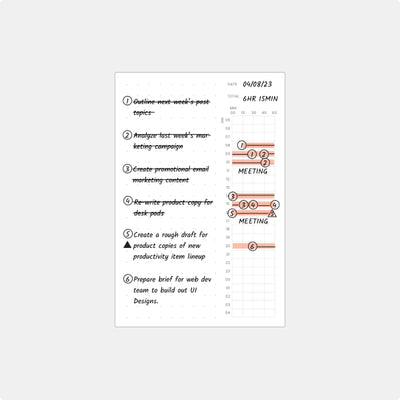
MDS Modular works as a refillable time blocking planner two ways: a Daily Insert with structured time blocks, and a separate Time Blocking Cards system you can use in or out of the binder.

The cards are designed so you can do tomorrow's time blocks the night before, slot them into the binder, and not have to think about your day until you sit down to start it.
Filofax sells time-blocking inserts as a third-party purchase. They work fine.
Moleskine 18-Month Weekly is week-on-two-pages with a single time column. Not great for time blocking.
Erin Condren Undated LifePlanner has vertical hourly columns in the daily-undated layout. Strong for time blocking, weak for everything else (the layouts are dense and busy).
Verdict. Hobonichi Cousin and MDS Modular tie for native time-blocking support. Erin Condren wins for sheer density of hour markings (sometimes a feature, sometimes overwhelming). Decision rule: if you time-block daily, this question matters more than aesthetics.
Q8: Can I track habits, goals, and wellness without a separate planner?
If your planner can't hold habits and goals alongside your daily tasks, you end up running parallel systems: one app for habits, a Notion doc for goals, the planner for tasks. Then you stop using one of them, and the system collapses. James Clear's research in Atomic Habits argues that the location of a habit cue matters as much as the habit itself. A habit tracker that lives next to your daily plan, in the same physical object, has a real behavioral edge over an app you have to remember to open.
The MDS Modular ships with a Wellness Insert, a Goals Insert, and a Habit Tracker Insert. Slot them into the binder alongside your weekly and daily pages. Everything in one place. If you have ADHD or a tendency to scatter your systems, single-binder consolidation is genuinely valuable. (See our guide to the best planners for ADHD for more on that.)
Hobonichi handles this through its yearly index pages, which you can repurpose for habit tracking with some manual setup.
Filofax sells third-party habit and goals inserts. They work, you just have to source them yourself.
Erin Condren has dedicated habit-tracking and goals modules in some of their planners.
Moleskine and bound planners generally don't have these, so you're back to running parallel systems.
Verdict. MDS Modular is purpose-built for this question (Wellness + Goals + Habit Tracker as standard inserts). Erin Condren is strong on dedicated modules. Hobonichi requires DIY. Avoid bound planners if you want one-binder consolidation. Decision rule: if you've ever lost track of a habit because it was in a different app, you need a planner that holds habits in the same binder as your tasks.
Q9: What if I skip days?
Be honest with yourself. You will skip days. Everyone does. The question isn't whether your planner accommodates skipping. It's whether your planner makes you feel bad about it.
Dated planners punish skipping by showing you the empty pre-printed Tuesday for the rest of the year. Undated planners just wait. Refillable systems let you literally remove the bad week and keep going.
This is the abandonment-cycle reframe and it's the single biggest reason undated planners exist as a category. The customer quote at the top of this article (John K.) is the cleanest articulation of it I've read. Read it again if you skipped over it.
Our customer data backs this up. From our review database:
"I will never buy another dated planner ever again."
— T.P., 5 stars
"I have spent lots of money and many different planners/journals looking for the right fit. I found in this one. This is actually my second one and I use both daily."
— Luis T., 5 stars
Verdict. Every undated planner on this list wins this question against any dated equivalent. Refillables win it harder than bound undated. The MDS Modular wins it hardest because you can literally pull skipped weeks out of the binder. Decision rule: if you know you'll skip days, prioritize refillable over everything else.

Q10: What's it cost over three years?
The price you pay on day one is not the price you actually pay. Here's the three-year math, because almost no buyer does this calculation and almost everyone should.
| Planner | Year 1 | Year 2 | Year 3 | 3-year total |
|---|---|---|---|---|
| MDS Modular (refillable) | ~$58 (binder + first inserts) | $12-25 (refill packs) | $12-25 | $70-83 |
| Filofax Original A5 + inserts | ~$80 (binder + inserts) | $15-30 (insert refills) | $15-30 | $95-130 |
| Hobonichi Cousin (English) | ~$50 | ~$50 | ~$50 | ~$150 |
| Moleskine 18-Month Weekly | ~$28 | ~$28 (every 18 months prorated) | ~$28 | ~$84 |
| Erin Condren Undated LifePlanner | ~$55 | ~$55 (annual) | ~$55 | ~$165 |
| Plotter Mini 5 | ~$220 (Italian leather) | $15-25 | $15-25 | ~$250-270 |
| Levenger Circa Junior | ~$45-90 | $15-30 | $15-30 | $75-150 |
| Clever Fox (popular non-refill comparison) | ~$45 | ~$45 | ~$45 | ~$135 |
| Full Focus Planner | ~$45 quarterly × 4 | $180/yr | $180/yr | ~$540 |
The Moleskine number assumes you actually finish each one in 18 months. Most people abandon and buy another, which doubles the cost.
The bigger insight isn't the savings. It's that refillable systems don't force you to abandon them when you skip a month. You're not buying paper; you're buying a system that survives bad weeks.
Verdict. MDS Modular and Moleskine tie on raw 3-year price (around $70-84), but the modular system survives more abandonment cycles. Plotter is luxury-priced. Full Focus is in a different cost universe. Decision rule: don't compare day-one prices, compare three-year totals.
Q11: How do I actually start using one without abandoning it in 6 weeks?
This is the question almost nobody asks before buying, and almost everybody asks themselves three months in. Here's what works, based on what we see in customer reviews and our own use.
Start with two inserts, not eleven. The most common abandonment pattern we see is buyers who load the binder with every insert type and then freeze. Pick monthly + daily, or weekly + habit tracker. Two layouts, max. Add a third only after a month of using the first two.
Plan the day the night before, not the morning of. Five minutes before bed beats 20 minutes at 9am. The planner becomes the "close the laptop" ritual instead of the "fight the morning anxiety" ritual. Hobonichi users, Filofax users, MDS users all converge on this. It's not a feature of the planner. It's a feature of when you write in it.
Don't backfill missed days. If you skip Tuesday, leave it blank. Backfilling turns the planner into a chore. Move on. Refillable systems make this physically easy (pull the page out). Bound planners require psychological effort (let it go).
Set one repeating block of "planner time" in your calendar. Sunday 7pm, weekly review, 15 minutes. That single recurring event is the biggest predictor of whether someone will still be using their planner in October.
Where to physically buy. Most of these are online-only. Moleskine is in most bookstores, Filofax has UK retail, Hobonichi runs occasional pop-ups in Tokyo and the US, Plotter is at JetPens. We're direct-to-consumer with a 100-day money-back guarantee. If the planner shows up and isn't right, send it back.
How we built the MDS Modular: paper, binder, inserts
If you're going to take advice from a planner-maker, you should know how they made their planner. Here's the design log, condensed.
The paper (covered in Q2 above)
southern China factory. About a year of testing. About 15 different paper weights against four pen types. Landed on 100 GSM off-white with a slight smoothness. Heavier weights felt better but killed portability. Lighter weights bled. The factory team thought we were obsessive. We were.
The binder
southern China factory. Vegan leather coating, multiple iterations on cover stiffness (too stiff and it doesn't lie flat; too soft and the planner feels floppy in the bag). The first prototype binders were genuinely worse than what we ship now. We had to redo the cover-coating process twice.
The clearest memory I have from that whole project is March 11, 2025, in southern China. Kenny and I were standing in the factory office and the third prototype was sitting open on the desk between us. The cover was scuffing along the spine after about ten open-close cycles. Kenny pulled it apart with his fingers (the binding wasn't glued yet) and the team lead came over with a sample of a new coating treatment they'd been using on luxury wallets. We rebuilt the spec on the spot. It took us another six weeks to get it right after that day, and it's the version we ship now. Spring-load 25mm rings to keep the profile slim. We acknowledge in our reviews that some heavy users want bigger rings; we hear that and a Pro variant with 30mm rings is on the next-revision list.

The honest trade-offs we made
- Fabric pen loop instead of leather. A bulkier leather loop adds about 4-5mm to the closed profile. We went with a slim fabric loop instead. It holds a pen securely without breaking the slim silhouette. Some users want the chunkier leather feel. We made the call for portability.
- 25mm rings. Smaller rings means a slimmer binder, which means it stays in the daily-carry slot. Heavy users (60+ pages) want bigger rings. We get it. A Pro variant with 30mm rings is on the next-revision list.
- Two-sided monthly inserts. A small number of customers want blank backs on monthly pages so they can slot weekly inserts between months. We chose two-sided to maximize the number of months per refill pack. It's a real trade-off and we listen to feedback on it.
From a customer who flagged the ring size:
"I wish the rings were a little bit bigger to allow flipping easier. Otherwise, it's great."
— Nicole K., 4 stars
We don't pretend our planner is perfect. It isn't. It's the planner that won the trade-offs we cared most about: portability over capacity, paper feel over price, modularity over a single fixed layout, and durability over visual flash. Different priorities would lead to different planners. That's fine. That's why this article covers eight.
The inserts
11 types, mapped to the 5 productivity styles (Q4). Each one was added because we saw the same workflow request show up in customer reviews and conversations multiple times. We don't add an insert because we want a bigger catalog. We add it because there's a use case the existing system doesn't cover. Here's what they are and what each one solves.
| Insert | What it is | Use case |
|---|---|---|
| Daily | Day-per-page with hourly time blocks + priority slots | Time blocking, deep work, structured days |
| Weekly | Monday-to-Sunday on two pages with notes column | Weekly review, recurring tasks, light scheduling |
| Monthly | Month-on-two-pages spread with key dates list | Big-picture planning, deadlines, project milestones |
| Focus | Eisenhower matrix layout (urgent/important grid) | Triage, cutting noise, deciding what to actually do today |
| Goals | Quarterly/yearly goal tracking with measurable targets | OKRs, big targets, progress check-ins |
| Habit Tracker | 30-day grid for habit consistency | Building or breaking habits, streaks, behavior change |
| Wellness | Mood, sleep, energy, gratitude tracking | Mental health awareness, energy patterns |
| Notes (lined) | Standard ruled paper | Meeting notes, journaling, free writing |
| Dot Grid | Blank dot-grid pages | Mind maps, sketches, brain dumps, bullet journaling |
| Time Blocking Cards | Standalone cards for daily time blocks (in or out of binder) | Pre-planning tomorrow, on-desk reference |
| Task & Time Cards | Pocket-size task cards for one-day-at-a-time use | Single-task focus, walking around with the day's plan |
The point of breaking it into 11 inserts instead of one rigid layout is that you choose your own depth. A Prioritizer might run Daily + Focus + Goals. A Visualizer might run Monthly + Dot Grid + Notes. An Adapter might rotate all of them across a year. The binder doesn't care.
Quick comparison table: 8 undated planners side by side
| Planner | Format | Paper GSM | Refillable | Layouts available | Year-1 cost |
|---|---|---|---|---|---|
| MDS Modular | A5 binder | 100 | Yes (modular inserts) | 11 insert types | ~$58 |
| Filofax Original A5 | A5 binder | ~80-100 varies | Yes | Multiple, third-party available | ~$80 |
| Hobonichi Cousin | A5 bound | 52 (Tomoe River) | No | Day per page + monthly + yearly | ~$50 |
| Hobonichi Weeks | Compact bound | 52 (Tomoe River) | No | Vertical week + notes | ~$30 |
| Plotter Mini 5 | Mini 6 / A5 binder | ~80-100 | Yes | Multiple, premium inserts | ~$220 (Italian leather) |
| Moleskine 18-Month Weekly | Large bound | ~70 | No | Week on two pages | ~$28 |
| Levenger Circa Junior | Junior discbound | ~80-100 varies | Yes (discbound) | Multiple, customizable | ~$45-90 |
| Erin Condren Undated | Coil-bound large | ~80 | No | Vertical / horizontal undated | ~$55 |
Our verdict, planner by planner
Here's the 4-and-4 split, upfront. The four I'd actually buy: MDS Modular, Hobonichi Cousin, Hobonichi Weeks, Plotter Mini 5. The four I wouldn't: Filofax Original A5, Moleskine 18-Month Weekly, Levenger Circa Junior, Erin Condren Undated LifePlanner. The reasoning is below. None of this is paid placement and we don't earn affiliate commission on any of these. We just sell one of the eight (the first one).
WOULD BUY MDS Modular Planner. Our pick for the focus-and-disconnect-from-screens reader. 100 GSM paper that handles fountain pens, slim A5 binder that actually fits in a bag, 11 insert types mapped to 5 productivity styles. Cons we acknowledge: 25mm rings are smaller than heavy users want, slim fabric pen loop instead of leather, two-sided monthly spreads. Best for: knowledge workers who value focus and want a system that adapts to them.
WOULDN'T BUY Filofax Original A5 ($80 binder + inserts). The legacy refillable that lives on its own brand recognition. Standard Original line uses a plastic-coated leather that doesn't patina (Reddit users have flagged this for years; if you want real leather you need the Holborn or Lockwood at $150-200). Inserts ship as mixed packs rather than purpose-built modules, so you pay for layouts you'll never use. Hole-punch quality is a frequent r/Filofax complaint: standard 5.5mm holes are too big for the delicate rings, leaving pages floppy. We'd buy the Holborn instead at almost double the price, but the Original feels like a premium product priced like one without delivering on either count. If you must: jump straight to the Holborn or Lockwood.
WOULD BUY Hobonichi Techo Cousin (A5). The cult Japanese daily planner. Tomoe River paper is genuinely special if you tolerate ghosting. Hourly columns make it ideal for time blocking. As of 2025, US customers can no longer buy covers separately from the techo book itself due to tariff workarounds, so plan for that if you're in the US. Best for: fountain-pen users who want a bound undated daily planner and don't mind committing to one layout for a year.
WOULD BUY Hobonichi Weeks. Same Tomoe River paper, compact week-on-two-pages format. The most pocket-friendly fountain-pen-friendly undated weekly planner on this list. Best for: minimalists who want one slim notebook for everything.
WOULD BUY Plotter Mini 5. Premium Japanese craftsmanship, Italian leather, beautifully made. Expensive at about $220 for the leather binder before you've added a single page. The kind of object you keep for 20 years. We respect the craft. Best for: buyers who want a buy-it-for-life heirloom planner and don't blink at premium pricing.
WOULDN'T BUY Moleskine 18-Month Weekly. Brand recognition, retail availability, and that's about it. Paper bleeds with most fountain pens (consistently the most-cited complaint on r/PlannerAddicts). Layout is uninspired as undated weekly planners go, and the bound format means you're committed to that single layout for 18 months. If you must: use a ballpoint and accept that the cover is the best part.
WOULDN'T BUY Levenger Circa Junior. The discbound system that defined the category, but the execution hasn't kept up. r/DiscBound users frequently report discs popping out, pages not laying flat consistently, and inconsistent paper weights between SKUs. The format itself (snap-on pages without opening rings) is genuinely useful for people who reorganize constantly, so if discbound is what you specifically need, look at Atoma or Happy Planner instead. If you must: buy from a single SKU you can verify in person and accept the disc-pop risk.
WOULDN'T BUY Erin Condren Undated LifePlanner. Dense layouts, lots of color, heavy on lifestyle aesthetic. As an undated monthly planner the spreads are some of the densest on the market. The deal-breaker is the binding: coil-bound, which means it's "undated" but not refillable. You're paying $55 a year for a planner you'll throw out, with customer service that comes up frequently in r/planners discussions both positively and negatively. If you treat planning as a creative practice and love the aesthetic, you already know you want one. We're saying for everyone else, the format is a step backwards from refillable. If you must: wait for a sale and buy the cover you'll love most, because that's the actual purchase decision here.
5 mistakes we see people make when buying an undated planner
These come from reading every Reddit thread we cited above, plus our own customer support inbox. If you avoid these, you'll save yourself a returns cycle.
- Buying a refillable system without checking the ring spec. Most refillable A5 planners use 6-ring binding, but ring diameters vary from 20mm (very slim, ~50 pages) to 35mm (chunky, ~120 pages). If you're a heavy planner user, a 25mm system will frustrate you within months. If you're a daily-carry user, a 35mm system is overkill. Match the ring size to your actual page count.
- Buying for the cover, not the paper. The cover is what you see in marketing photos. The paper is what you write on every day. Filofax Original looks gorgeous and uses 80 GSM paper that bleeds with most fountain pens. If aesthetics drove the purchase, get ready to use a ballpoint forever.
- Buying a Hobonichi Cousin if you only journal occasionally. A day-per-page format requires a daily commitment. People who plan 2-3 times a week end up staring at empty pages and feeling guilty, which kicks off the abandonment cycle the Hobonichi format was supposed to solve. If your real cadence is weekly, get a weekly planner. The Hobonichi Weeks or a refillable system suits this much better.
- Buying dated when your habits are still forming. If you've never stuck with a planner before, dated formats punish you for missed days. Start undated for at least one full year before considering a dated planner. Honestly most people stay undated forever once they switch.
- Buying eleven inserts on day one. We literally sell 11 insert types and we still tell new customers to start with two. Pick monthly + daily, or weekly + habit tracker. Add a third only when you have a specific use case the first two don't solve. Loading up the binder day-one is the most common reason new modular planner users abandon the system in the first month.
If you want a cleaner version of point 5 with a step-by-step setup, see Q11 above.
How we did this comparison
Quick methodology note for anyone who wants to know where the numbers came from.
MDS Modular data is firsthand. Paper testing was done at our southern China paper factory across 2024-2025 (~15 weights, 4 pen types, documented in Q2 above). Binder design and prototyping was done at our southern China factory across the same period. Customer feedback comes from our review platform: 2,871 verified reviews across the MDS product line at 4.6 stars average, of which 50 are specifically about the Modular Planner ecosystem (binder, inserts, kits).
Competitor data is from primary research and official sources. Specs and pricing come from each brand's official product pages. For customer feedback patterns, we did our own meta-analysis of public Reddit discussions:
- 5 subreddits reviewed: r/Filofax, r/hobonichi, r/PlannerAddicts, r/planners, r/DiscBound
- 48 threads deep-mined for top comments
- 443 total comments reviewed across those threads
- 121 top-scoring comments (score ≥ 3 upvotes) extracted as signal
- Threads reviewed in April 2026
The most-cited concerns we surfaced from those 121 top comments: paper quality (30 mentions across all brands, dominated by Moleskine bleed complaints), ring or disc quality (20 mentions, Filofax hole-punch and Levenger disc-pop issues most cited), price (6 mentions, dominated by Plotter and Erin Condren complaints), fountain pen compatibility (5 mentions). Specialty retailers JetPens and The Cramped were used as cross-reference on Japanese planner specs (Hobonichi Tomoe River paper, Plotter leather grades).
Pricing is in USD as of April 2026, taken from each brand's official US-facing site or Amazon listing. Prices fluctuate. Our 3-year cost calculations assume average refill cycles for refillable planners (one refill pack per year for moderate users) and one new planner per year for non-refillable formats.
Verdicts reflect our opinion as planner-makers and planner-users. We disclose at the top that we make one of the eight planners on this list. We don't earn affiliate commission on competitors. Where another planner wins on a specific question, we say so directly.
This article was last reviewed and updated in April 2026. We update it when new information is available, when our recommendations change, or when reader feedback flags something we got wrong.
Frequently asked questions
What is an undated planner?
Are undated planners better than dated ones?
What is the best undated planner for ADHD?
What paper weight is best for an undated planner?
Are refillable planners cheaper over time?
Will an undated planner work with fountain pens?
How do undated planners handle monthly and weekly planning?
What is the difference between an undated planner and a notebook?